Across the North Pacific, few seabirds lead a life as extraordinary as the Ancient Murrelet (Synthliboramphus antiquus). Roughly half of the world’s population returns each spring to breed on the islands of Haida Gwaii, making this remote archipelago one of the species’ most important strongholds.
Known as SG̲in X̲aana, or “night birds,” by the Haida Nation, Ancient Murrelets embody the deep connection between ocean and forest that defines this coast. Their story unfolds under the cover of darkness; in a world few people ever witness.
Each spring, breeding pairs return to remote islands and nest in burrows hidden beneath fallen logs, tangled roots, rocky crevices, and grassy hummocks. During the day, the forest appears quiet, but after sunset the colony comes alive. Ancient Murrelets visit their nest sites only at night, slipping silently between the sea and the forest canopy.
After laying one or two eggs, the adults take turns incubating them in the darkness. Then, just two days after hatching, one of nature’s most remarkable journeys begins.
Unlike many seabirds, Ancient Murrelet chicks are never fed at the nest. Instead, under a moonless sky, tiny down-covered chicks emerge from their burrows and make a perilous dash through the forest. Guided by the calls of their parents waiting offshore, they navigate roots, branches, and dense vegetation in near-total darkness.
Once reunited on the water, the family swims away from land together, leaving the forest behind. The chicks will grow up entirely at sea, nourished by the rich waters that surround Haida Gwaii.
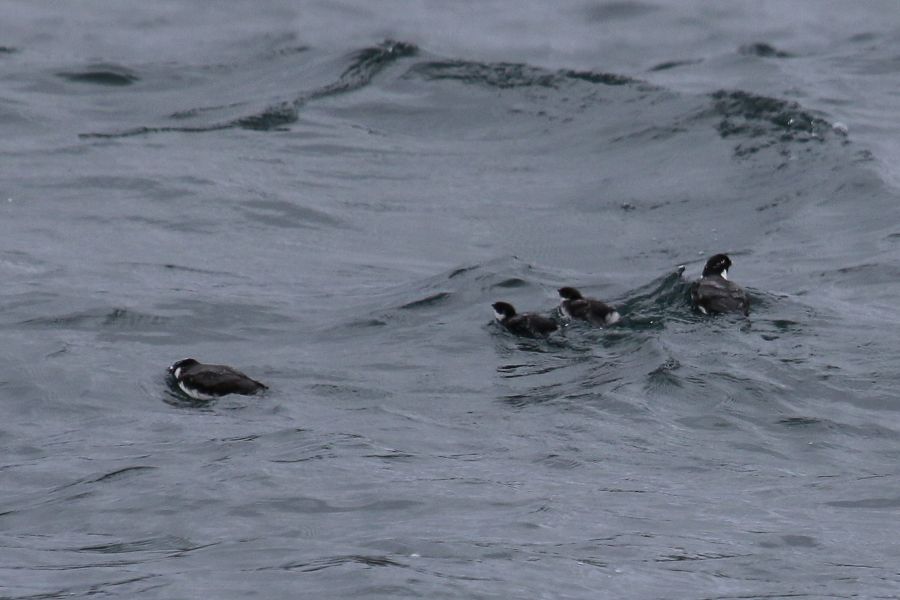
For the remainder of the year, Ancient Murrelets live on the open ocean, feeding on small fish, krill, and other zooplankton. Their brief return to shore each spring is one of the coast’s most fascinating wildlife spectacles, a fleeting moment when forest and sea become inextricably linked.
Spring is also the best time to observe large numbers of Ancient Murrelets and other seabirds as they move between these two worlds. During Bluewater Adventures’ early-season Haida Gwaii expeditions, guests may have the opportunity to visit the field camp of the Laskeek Bay Conservation Society on East Limestone Island.
For more than three decades, researchers and volunteers with the Society have monitored Ancient Murrelet populations, creating one of Canada’s longest-running seabird research programs. Their work has contributed enormously to our understanding of these elusive birds and the challenges they face in a rapidly changing world.
Continuing the Story
Ancient Murrelets face a number of pressures, from marine pollution and changing ocean conditions to impacts from commercial fisheries. Yet one of the greatest threats has come from an unexpected source: invasive rats.
In Part 2, we’ll explore how introduced predators devastated some colonies, and how the Haida Nation, Parks Canada, Fisheries and Oceans Canada, and conservation partners are working together through the SG̲in X̲aana Sdiihltl’lx̲a: Night Birds Returning Project to restore and protect critical breeding habitat across Haida Gwaii.